
GRADE 7 CURRICULUM OVERVIEW
Ages 12 - 13 years old
Grade 7: Exploring International relations, migration, and resource management
In Grade 7, students engage in a dynamic curriculum that integrates various thematic units to encourage a comprehensive understanding of the world. They explore beliefs, values, and religions and gain perspective on similarities and difference. The curriculum covers human migration – examining its causes, politics, and impact on communities and individuals. Students learn about managing finite resources responsibly and the importance of being the change they want to see in the world. They learn about different systems of governance and their effect on citizens rights, study energy sources and their economic and environmental impact, and emphasize the power of cooperative individual action in effecting personal and social change. Together, these units encourage students to connect their learning to real-world solutions, and promote personal and social responsibility.
01
Language Art
Writing
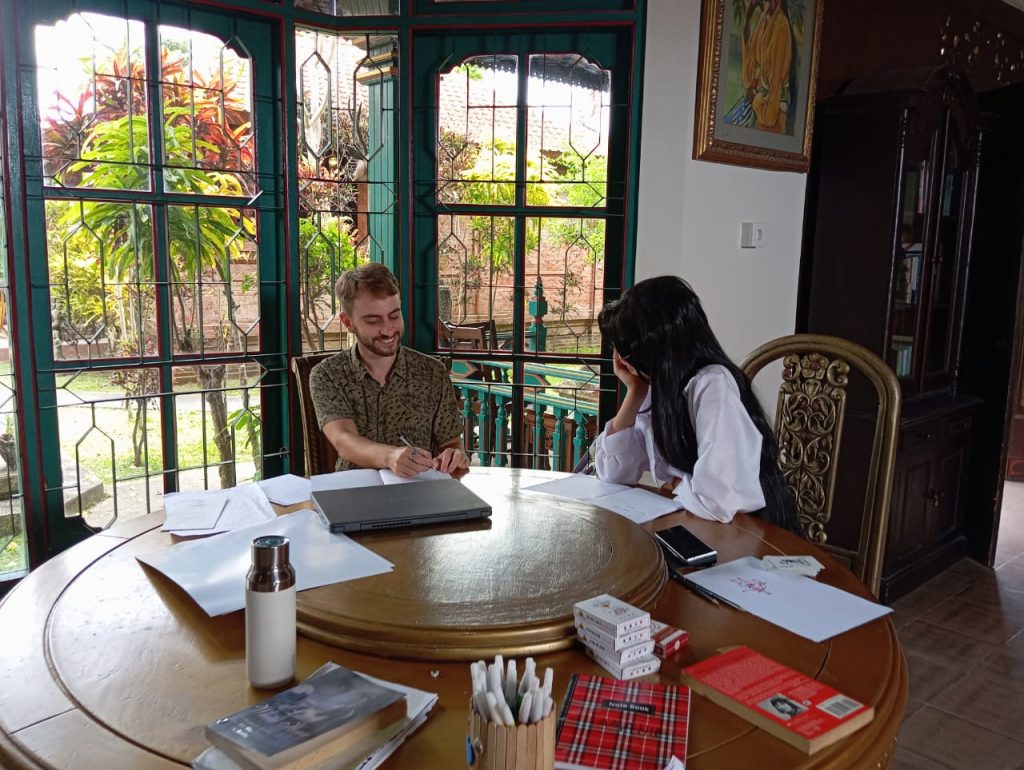
Developing skills in effective wriiten communication, conducting surveys, and interviews.
Reading
Synthesizing and summarizing information.
Speaking & Listening
Effective communication in various contexts.
Novel Studies
In-depth analysis of "The Giver" by Lois Lowry and "A Long Walk to Water" by Linda Sue Park.

02
Mathematics
Rational Number Arithmetic:
Students learn operations involving rational numbers, addition, subtraction, multiplication, and division.
Expressions, Equations, and Inequalities
Introduction to algebraic equations and understanding inequalities.
Ratios, Rates, Percentages, Fractions, and Decimals
Focus on practical applications and problem-solving using mathematical concepts.
Probability and Sampling:
Basics of probability theory and how to collect and interpret data samples.
03
Science
Nature vs. Nurture, Mitosis/Meiosis
Understanding genetic and environmental influences on organisms, cell division, and reproduction.
Wave Behavior (Light and Sound)
Exploration of wave properties and their applications in light and sound.
Weather vs. Climate
The difference between climate and weather is time; weather refers to short-term atmospheric conditions, while climate is the average of those conditions over a long period, typically 30 years or more.
Properties and Laws of Gravity
Study of gravitational forces and their impact on physical bodies.
Physiology and Biology of Plants and Animals
Examination of biological systems, functions, and adaptations in living organisms.

04
Social Studies
Internationalism
Understanding cultural differences and the interdependence of societies around the world.
External Challenges (Wars, Migration, Politics)
Analysis of historical and current challenges, and their effects on societies.
Human and Natural Environments
Study of the interaction between humans and their environment, including the conscientious utilization of resources.
Governance and Freedom
Examination of different governance systems, their roles in managing societies and their responsibility to uphold Individual Rights and Freedoms.
05
Entrepreneurship
Basic Business Concepts
Understanding what a business is, different types of businesses, and the basics of how businesses operate.
Idea Generation and Creativity
Learning how to brainstorm ideas for products or services and thinking how to create value and be of service to others.
Marketing & Branding
Understanding the basics of marketing, how to create a brand, and ways to promote a business.
Financial Literacy
Introduction to basic financial concepts such as money management, budgeting, and profit and loss calculations, breakeven analysis.
06
Critical Thinking
Sharpening focus
Developing logical thinking and problem-solving skills through puzzles, games, and cooperative endeavours/challenges.
Propaganda
Learning the history of propaganda, the various techniques employed, such as dysphemisms and framing, and modern uses in media and advertising.
Social Media
Examining the effect of social media on the human mind and human emotions. Understanding addiction.
Digital Literacy
Gaining familiarity with basic computer operations, internet safety, and responsible use of technology.